The Disappeared Houses

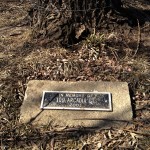
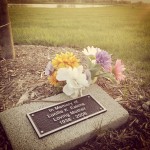
IMG_1316On a walk last month, Adam and I noticed a memorial plaque under a tree… for a street address. Curious. (If you want to go find it, it’s along Lily Cache Greenway between Orchard and Plainview.)

When we got home I searched for “109 Arcadia Court” on Google Maps and a little red tag popped up in the middle of some grass and trees. Nothing seemed to be there, but Google recognized the place:

Screen Shot 2013-03-25 at 8.40.49 PMThe real estate agent who helped us find our house, Ruth Blumenstein, has lived in Bolingbrook for decades and if there was something about this address to be known, she would know it, so I emailed her.

109 Arcadia Court – I mean, it does sound like some kind of utopian, mythical place.

And there was a story! But not exactly utopian. Ruth told me that, in the 80s and 90s, flooding along Lily Cache Creek (the dark ribbon in the satellite photo) was so bad that the Village decided to buy those houses, tear them down, and turn the land into a park. You can see a big green swath along the creek there, where there used to be 11 houses, two on Arcadia and nine along Avondale.

The Chicago Tribune published something about it, back in the day.

A street of disappeared houses. A community only 50 years old and already we have a sort of ghost town. And a family who loved that house and bought a memorial for it.

I love the stories I can find, just by taking walks.

Foreclosure

This are two foreclosed homes on our block, down from three. Will County has had one of the highest rates of foreclosures in the state, and Bolingbrook has been one of the epicenters.

Some foreclosed homes are kept up well, but this one was pretty neglected. The front door looked like something out of a war zone:

That screen door couldn’t stay shut by itself. The yard was raggedy. Eyesore central.

There’s something painful about an obviously empty house, even when it’s not an eyesore like this. It’s like a corpse –  physical evidence of what used to be a whole life. And, of course, you wonder about the story of the foreclosure. Was the owner foolish? Too hopeful? Or did they lose their job or have a family emergency? Whatever the story, you know there’s heartbreak there. On your block, you can have two, three or four two-story memorials to heartbreak that you drive by every day. And maybe more around the corner.

So many human crises happen behind closed doors. Foreclosure isn’t like that.

But that particular house has been fixed up recently. Some guys showed up with a dumpster for a few days, although I never saw what they tossed into it. Broken appliances? I never had the guts to peek in the windows to see what kind of condition the interior was in.

But now the lawn is mowed and the door is cleaned up. The shaggy bushes got trimmed. The screen door stays closed. Now the outdoor lights are always on, which is a bit ghostly but probably intended to make it looked lived in.

Still, the local newspaper, which everybody gets free, collects in the driveway…

It’s not for sale, yet. Just standing empty for now. Lights on.

Memorial tire swing

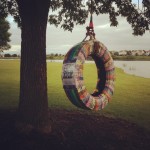
The park near our house is full of memorial trees, and now, we also have a memorial tire swing.

An 11-year old girl, Jordan Oliver, drowned in a retention pond behind her school last week. She was playing along a bridge with a bunch of other kids, slipped into deep water, and didn’t come back up. There’s a lot of talk about whether bullying was involved, but rumors spread after a tragedy. Whatever happened, a little girl died and the children who with her will never be the same, whether someone dared her to go in deeper water or not.

Jordan lived in my neighborhood, I learned yesterday. I was walking the dog in the late afternoon, and saw two little girls standing, with some purpose, by this colorful tire swing. A woman in a yellow sport shirt and I stopped to talk to them. The girls, absent-mindedly but constantly, ran their hands over the tire as they talked to us. The girls and this woman were all neighbors of the Oliver family. It sounded as though they’d been planning to make a tire swing together and Jordan had been helping to clean off an old tire in someone’s yard.

Jordan’s brothers made this tire swing (she was the youngest of four). It’s wrapped in colored duct tape and there are little messages all over it, written with a sharpie. Including this plea, “If this tire swing falls down, please return to the Oliver family.”

I’m still devastated by the death of this little girl. But I love seeing this swing. I hope it helps the family move through their grief.

(I know it seems strange that no one can play on the swing, but it’s decorated and hung for display, not for swinging…)

The Bolingbrook Memorial Tree Program

How does a human settlement become more than land with houses on it? How do people start to merge the story of their lives and relationship with the ground they live on? One of the ways humans mark ground with stories is by making graves.

Farming families started digging graveyards in the Bolingbrook area almost as soon as they settled here. (People died early and often back then.) A cemetery on Boughton, near Pinecrest, has graves dating, at least from what I could see, to the 1840s. They’re surrounded by a suburb where not much dates before 1959. Below, Florentine Godfrey, who died October 1, 1876.

Barbers Corners Cemetery

But nowadays, graveyards aren’t the only resting place for the dead. Several families in my church keep the ashes of their loved ones in urns at home. You’ve probably seen more hand-made memorials along highways and major roads than you can count. My dad and his siblings “sprinkled” my grandfather in some woods on the side of a hill in southern Indiana, back in 2005.

The park near our house, where I walk our dog most days, is full of “memorial trees.” Each has a metal plaque on a concrete slab at its foot, and is part of  a Memorial Tree Program sponsored by the Bolingbrook Park District. For $325, you can dedicate a tree to a loved one, a special event, or an organization. So far, I’ve only seen trees dedicated to people who have died.

Lucille Eakens

Maybe a park seems more friendly than a graveyard. You can imagine your loved one watching bicycles whoosh by, hearing dogs barking at each other, or feeling kids’ feet pounding the soccer fields… instead of watching hearses roll by, hearing pastors say sad words, or feeling ground get dug up and replaced, dug up and replaced, dug up and replaced. It’s a lot cheaper, too.

Megan Wiborg

How old was Megan when she died? Did she die suddenly? Was there an illness or an accident? Did her family choose this park for her memorial tree because they lived in the neighboring subdivisions? Do they still?

These plaques feel full, even when all you see is a name and a year.

Kelsey Arnold

Emily Arnold

Two women. A year apart. Two trees next to one another. Were they sisters? A mother and daughter? This one always breaks my heart.

So, our local park doubles as a kind of graveyard. There aren’t any remains involved (unless a family brings them by cover of night, I suppose), but just the same. These trees aren’t just trees. There’s a story, a family, and a life behind each one. Our park isn’t just about sports, property values, or flood control, the things I imagine it was intended for. It’s also become a place to remember the dead.

Jack L. Noble

Jack has two trees (and two plaques) right next to each other, alongside a playground. I picture a grandfatherly man, who enjoyed children.

See that slender trunk? All those memorial trees are still young. This park is only twenty years old. That’s a man-made pond, behind Jack’s tree. You can see giant outdoor lights in the background that illuminate kids’ soccer games and produce some ferocious light pollution on summer nights. The whole park is surrounded by subdivisions and town homes. It’s a purely manufactured place. It could be a park in almost any suburb in the northern U.S.

Still, the memorial trees stake a claim: people live here, people die here. Particular people, with names, stories, and people they love. No matter what, a piece of land starts to tell a story about the people who have lived there. And died there. Whether it’s 1876 or 2006.

Rest in peace, Florentine, Lucille, Megan, Emily, Kelsey, and Jack.