stories about the suburbs, church life, and my house
Growing up I rode bikes around my city neighborhood and the lakefront with my dad and my brother, but sometime in high school I got this (hopefully false!) sense of premonition that I would get some kind of spinal injury from riding a bike. So I stayed away from them for years.
Now, living out in the far suburbs, it’s pretty easy to go for a bike ride and I feel less paranoid. It seems as though developers and mayors realized in the 1980s and onward that people like bike trails and they started incorporating them into community planning. Bolingbrook has a ton of bike trails, although admittedly, they don’t all connect to one another or go anywhere especially interesting. One even is abruptly interrupted by a large creek which apparently no one ever got around to building a bridge over.
There are also forest preserves everywhere out here. Two weekends in a row, Adam and I have put our bikes on the car and driven to some woods or prairie with a crushed limestone trail winding through it for 5-10+ miles, less than twenty minutes from our house. Here’s the one we went to today:
Waterfall Glen is a green necklace around Argonne National Laboratory. Although the Lab is surrounded by barbed wire fence, so you only see these buildings from a distance. But there’s lots of other nice things to look at: the namesake waterfall (although it was built by the Civilian Conservation Corps in the 30s, and not Mother Nature), a model airplane field, prairie, marshes, and woods, flooded quarries, an old cemetery, stone and concrete building remains, and lots of wildflowers. There are hills, twists and turns, and some nice views, so it’s not total Illinois flatland, either.
I wish I could’ve recorded the spring peepers, chirping away along the trail, but I did take some photos from my ride: (Adam likes to go fast while I pedal leisurely and look around, so we split up on bike rides)
(Yes, our Illinois expectations are a bit low concerning waterfalls…)
“Lincoln Park Service”? — The Lincoln Park Commission (predecessor of the Chicago Park District) owned some of this land from 1907-? and used it for topsoil and a plant nursery. But I could be wrong.
Wildflowers… including Dutchman’s Breeches, lower left.
This bike was a family birthday present. No shocks, but I love everything else about it. Three gears is great for me. Simple is good.
Adam with his iPhone – he tracks all kinds of things about the ride. My man loves data.
Where will the next ride be?
On a walk last month, Adam and I noticed a memorial plaque under a tree… for a street address. Curious. (If you want to go find it, it’s along Lily Cache Greenway between Orchard and Plainview.)
When we got home I searched for “109 Arcadia Court” on Google Maps and a little red tag popped up in the middle of some grass and trees. Nothing seemed to be there, but Google recognized the place:
The real estate agent who helped us find our house, Ruth Blumenstein, has lived in Bolingbrook for decades and if there was something about this address to be known, she would know it, so I emailed her.
109 Arcadia Court – I mean, it does sound like some kind of utopian, mythical place.
And there was a story! But not exactly utopian. Ruth told me that, in the 80s and 90s, flooding along Lily Cache Creek (the dark ribbon in the satellite photo) was so bad that the Village decided to buy those houses, tear them down, and turn the land into a park. You can see a big green swath along the creek there, where there used to be 11 houses, two on Arcadia and nine along Avondale.
The Chicago Tribune published something about it, back in the day.
A street of disappeared houses. A community only 50 years old and already we have a sort of ghost town. And a family who loved that house and bought a memorial for it.
I love the stories I can find, just by taking walks.

I saw Anne Stentiford’s name on this sign in January, wondered about it, and decided to do some detective work. (Sort of like my obsession with manhole covers last fall.)
I found her address online and I wrote to her. She was very kind and wrote me back. This NO SWIMMING / SKATING sign is the only one she’s designed, and it all happened because of an idea she had in graduate school.
In the late 1960s, Stentiford was training to be an elementary school teacher and she needed a project for one of her classes. She’d heard one professor lament the lack of a NO SWIMMING sign that even small children could understand, and so she got to work. She asked her classmates to help her ask over 250 students in their classrooms to draw pictures of what they thought a NO SWIMMING sign should look like. Stentiford told me almost all the children used the color RED and they all wrote the word “NO.” They almost all drew a picture of what might happen to them if they swam somewhere they weren’t supposed to. As Stentiford put it in her letter to me, “Tell a child what not to do and he’ll ask ‘WHY?’ Show him what might happen to him and you’ll have a good chance of him responding and retaining the message.”
Anne copyrighted her design. In the early days, she and her husband produced the first signs themselves, with help from friends with a machine shop. Later, demand grew and because signs like these must also meet certain government specifications, Anne contracted a large sign company to fabricate the signs. Here, in her own words, she remembers:
Making the signs in our friend’s machine shop was “a trip”. Our friend ordered .080 gauge aluminum and he cut out the shape with radius corners and pre-punched holes on standard centers… On Saturday nights the 4 of us silk screened the image on the signs, or I should say that the 2 men did that while the 2 women stood with paper towels and mineral spirits to wipe off the images that didn’t come out right. On Sunday nights we went back to stack the signs that were standing all over the shop to dry. This all happened while I lived in Lakeland, Florida. Shortly after that my husband got transferred in his job to Baton Rouge, LA. At that time I quit teaching and contracted with a nationwide sign company to make the signs.
That company is still making the signs and because I’m almost 80 years old I no longer actively market the signs other than through the website and a mailing that I did last year. I feel an obligation to continue making the signs available and I do get orders for the signs. The signs are sent to me from the fabricator and I actually ship them and process the orders myself.
It’s been a pleasure to correspond with Anne and learn more about her signs. I’m grateful she was willing to share so much with me.
If you’d like to order one of her signs, check out her website. 
Looks like someone was doing donuts with their ATV on our local baseball field the other day.
I always thought this only happened in more rural areas. But I guess someone got desperate. Or intoxicated?
I often see tracks along highways or major roads, or the patches of ground near exit ramps. But a park?
Or could it have been a car or truck? At least they didn’t tear up the turf.
And someone stole this dog decoy, which was supposed to keep geese off the soccer fields. Sheesh. Lots of criminal mischief around here.
(I just like to type that: criminal mischief.)
Some prankster moved two of the park picnic tables into the pond a few weeks ago. Then it got cold, fast, and the tables were frozen in place.
I tried to get all Monet with them, and take pictures in different light…
Notice the snow above was in tiny clumps – reminded me of popcorn.
Early morning, with dog tracks.
Midafternoon, dog tracks still visible.
Admittedly, I don’t think I can compete with the real deal…
But it’s still fun.
On a dog walk, I noticed this sign for the umpteenth time. There’s just something about a person with three holes for eyes and a mouth… My husband took some family pictures for some folks at our church and he took one of them standing around one of these signs, holding their arms in the air, eyes open wide, and making Os with their mouths. Hilarious!
These have a neat efficiency to them. All the park district has to do, when the Danger Season for Skating changes back to the Danger Season for Swimming, is swap out a single word. The picture shows an unwanted future both for swimmers and skaters. For some reason, I find this very clever.
When I was taking the picture, I got a little closer and noticed something else.
Who’s this Anne Stentiford? And what happened in 1969?
After some internet research, I discovered that Stentiford is the owner of a sign company in Baton Rouge, called Tri-Safety Symbol Signs. It doesn’t seem to have a website. All I can think is that she copyrighted this sign design in 1969. Maybe she came up with the three-hole-faced person and the switchable “SKATING/SWIMMING” idea? But why isn’t there a copyright symbol there, too?
I found someone on eBay who is trying to get some mileage out of that “1969″ date, claiming this sign is “Vintage.” Also, he claims it’s a sign from “Baton Rouge, LA.” He’s asking 85 bucks. Buyer beware. At least the BB holes and faded color give it some character – maybe that’s worth the $85. Like you can just imagine it hanging over a Louisiana swimming hole where backwoods kids shot it up between cannonball dives.
Or maybe they lived in New Jersey.
Maybe I’ll start checking out other signs, to see if they have names on them? Manhole covers do.
I’m still curious about Anne Stentiford… just seems like there’s a story there. Maybe I’ll write her and find out?
I often tell people that Bolingbrook is a diverse community. We say things like, “My block is like the United Nations!” Another fun place to see this is at one of our big box grocery stores:
Daikon radish, yucca root, a melon (?), wheatgrass, leeks, carrots… But let’s start with some hard data.
2010 census data for Bolingbrook:
White/Non-Hispanic: 41.7%
Black: 20.4%
Hispanic/Latino: 24.5%
Asian: 11.4%
Reporting more than two races: 3.4%
Hard to believe that only 3.4% of us claim to be biracial. Good ol’ Chicago folks – segregation is a deep part of our history. But I have a feeling “biracial” eating is more common. With that, on to the:
2012 grocery store "data": (?)
Many, many kinds of peppers: tomatillo, serrano, jalapeno, poblano… also some jicama and chayote.
Bok choy, tat tsoi, daikon radish, Chinese broccoli, pea pods, those beautiful onions, and that mysterious melon whose name I can’t recall.
Yucca, horseradish, oregano, basil, mint…etc.
Those orange wagonwheel things are called duros. Made from a wheat-base. You can deep fry them for a snack, or so I learned from Wikipedia. Also rice, dried beans, and tamerind seed pods. (Mostly Mexican produce, here, in case it’s not clear.)
Canela = Cinnamon // Tamerindo = spice in whole pods // Piloncillo = unrefined sugar
Squint and pretend you’re in a market in Mexico somewhere… so pretty!
There’s also some foodie, hipster-type choices. Carrots with tops. Arugula. Golden beets. Leeks.
Soul food! Mashed potatoes, gravy, macaroni & cheese, fried chicken, fried potatoes.
Soul food: turnip & mustard greens, collards.
A staple of North American produce…
This is what my mom calls “White Soul Food”: jello, spinach dip, imitation crab salad, pasta salad with ranch dressing and bacon.
Yes, you can find it all here in Bolingbrook. And that was just the produce section!
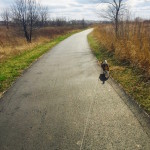
I love taking walks in winter. It’s still. Nobody is around. Everything is exposed down to the most basic level. And I love the cold, when I have a coat and gloves, anyway. Of course, gloves have to come off for taking photos, so for a number of these, so I lost the feeling in my fingers more than once, trying to get the right shot.
Some things Odo and I saw this afternoon (before 5pm – hard to believe)…
You can see a patch of prairie that was burned by the Park District last month, on the left, there.
Sunset with beagle, lower right.
Ice, with dots!
I’d like a glassware set with this pattern…
Thanks for getting me out of the house, dog.